Home › Services › Siding Repair and Trim
Not every siding problem is an elevation. A torn-off piece after the derecho, soft trim under a window, or a fascia board that rotted behind the gutter are contained repairs, and they are the ones that keep small water problems from becoming wall problems.
Pieces pulled loose or broken by a gust, or struck by a limb.
Trim absorbs moisture at its cut ends. Once soft, it holds water against the wall.
Water that overflows a gutter or backs up from a clogged drip edge rots the fascia board and then the soffit.
Sealant at joints and penetrations is a maintenance item, not a permanent seal.
This is where siding and roofing repair overlap. See roof leak repair.
A new piece in an old wall needs a paint plan. Many communities also require approval for a color change.
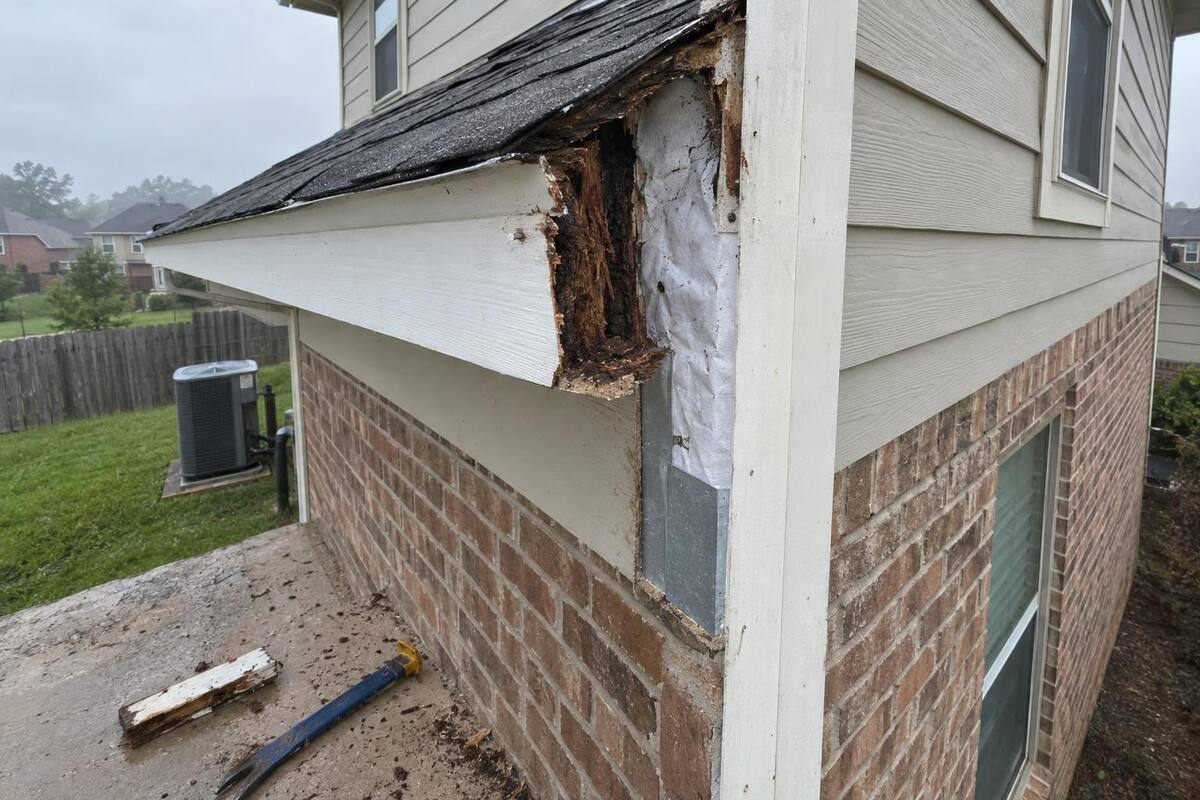
One rotted corner board is a repair. Rot at the bottom edge of a whole wall is an elevation. Similarly, one damaged plank on a fiber-cement wall is a replacement of that plank, while a hardboard wall with swelling at every joint is not made better by replacing single boards. If the house has the older upper-story hardboard pattern, the honest question is whether the remaining boards are worth the money; see hardboard siding replacement.
Exterior painting on this site is a step in a siding job, not a service on its own. A repaired section that is not painted or primed is a leak path waiting to develop. The contractor you are connected with will scope paint alongside the repair.
Yes, if it closes an opening. Water behind siding does more damage than the missing piece suggests.
Fiber-cement is easier to match than aged hardboard, whose profiles can be hard to source. Expect a visible transition on older walls.
Like-for-like repair in the same color often does not; a change in color, profile or material usually does. Ask the association.
Describe what you are seeing and get connected with an independent contractor who works Katy houses.
Call (832) 772-2076 Request an Inspection Katy Roofing