Two hard wind events in eight weeks left a lot of Katy roofs with contained damage and a lot of years still in them. A repair is the right answer when the failure is specific and the rest of the roof is sound. It is the wrong answer more often than people expect.
The seal strip breaks and the tab lies back down. Hand-sealing individual tabs is a legitimate repair when it is caught early and the shingle itself is undamaged.
Caps take the most direct wind load and are commonly displaced first. Cap material has to be sourced to match the field shingle line.
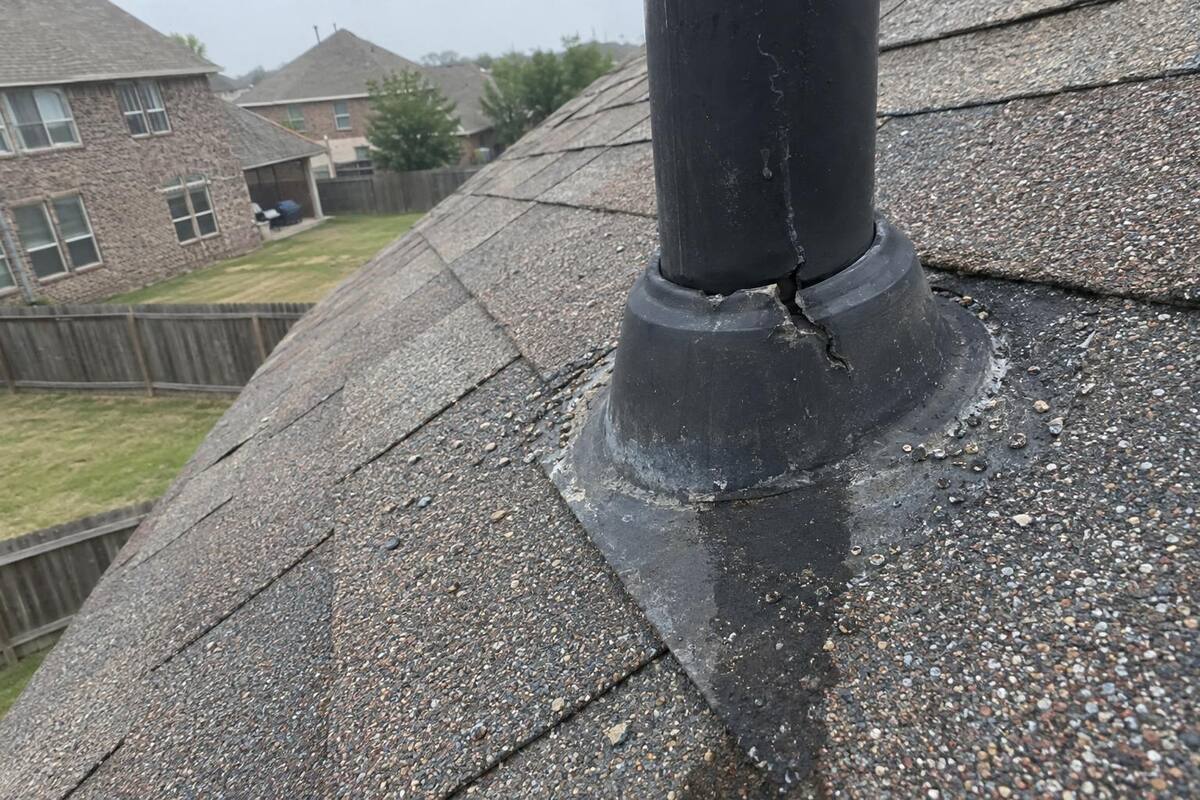
The rubber collar around a plumbing vent is the shortest-lived part on a Texas roof. Sun takes it before the shingles go.
Two-story brick and siding elevations put long roof-to-wall runs on almost every Katy house. Flashing there bends in wind and fails at the end of its life.
A limb strike can crack decking under intact shingles. The repair is a decking section, not a patch.
Nails back out as sheathing swells and shrinks through wet and dry cycles, then tent the shingle above.
The useful question is how much roof is left. A well-done repair on a nine-year-old roof buys years. The same repair on a roof at the end of its life buys a season. Three things push toward replacement: an age near or past the shingle's rated life, more than one leak in separate places, and granules collecting in the gutters. A newer roof that took wind damage across a whole slope can also be a replacement question, because a slope of unsealed tabs is not fixed by sealing every one of them.
A quick way to tell which situation a roof is in: a roof inspection that includes the attic. It costs less than one wrong repair.
Roofing cement smeared over a vent boot or a flashing joint stops water for a while. In Katy humidity it then cracks, holds moisture against the decking, and hides the failure until the wood underneath has gone. A roof that has been patched this way more than once tells you more about its remaining life than the current leak does. If water is already inside, see roof leak repair.
Rarely exactly. Shingles fade and lose granules in years of sun, and manufacturers change blends. On a rear slope it hardly matters; on the street side it may.
It can. Ask the contractor whether the repair method preserves the manufacturer's terms before work starts.
Faster than expected in this climate. Wet decking stays wet in high humidity, the sheathing delaminates, and by the time a ceiling stain appears there is insulation to replace as well.
Describe what you are seeing and get connected with an independent contractor who works Katy houses.
Call (832) 772-2076 Request an Inspection Katy Roofing